

Amit Kapur, Founder, Chairman & MD of NICO Nanobubble India Co.
From Compliance to Competitive Advantage in Wastewater Treatment
Municipal and industrial wastewater treatment plants are no longer judged solely on discharge compliance. Today’s benchmarks extend to energy efficiency, footprint reduction, chemical minimisation, carbon intensity, reuse readiness, and resilience under fluctuating loads. Conventional process trains while proven are increasingly strained by tightening norms, rising power tariffs, land constraints, and sustainability mandates.
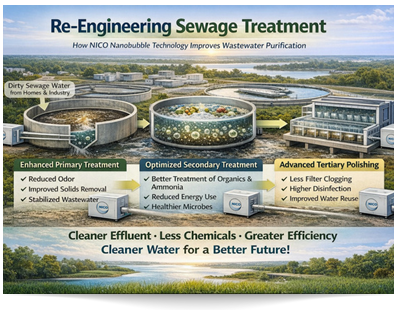
This is precisely where NICO Nanobubbles position itself not as a disruptive replacement, but as a high-impact process intensifier unlocking latent performance across primary clarification, biological treatment, and tertiary polishing, without civil overhaul.
The Hidden Inefficiency in Conventional Treatment Trains
Across most STPs and CETPs, inefficiencies emerge not because of poor design it because of mass-transfer limitations:
- Oxygen delivered, but not effectively transferred
- Mixing achieved, but micro-zones remain anoxic
- Chemicals dosed, but contact efficiency is sub-optimal
- Polishing units installed, but upstream instability overloads them
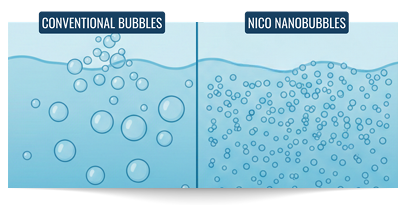
Nanobubbles, ultra-fine gas bubbles (<200 nm), fundamentally change this equation by decoupling performance from brute-force energy and chemicals.
Primary Treatment: Conditioning Begins at the Inlet
In conventional thinking, primary treatment is “mechanical.” In reality, it is the first biochemical conditioning step. In this nanobubbles add values,
- Micro-oxygenation of influent channels & equalisation tanks
- Suppression of septicity and odour formation
- Improved floc formation and settleability
- Reduced shock loading on downstream biology
By eliminating anaerobic micro-zones early, nanobubbles stabilise influent characteristics, translating into smoother biological kinetics downstream. So, the outcome is lower H₂S, reduced odour complaints, improved primary sludge quality, and more predictable secondary treatment performance.
Secondary Treatment: Redefining Aeration Efficiency
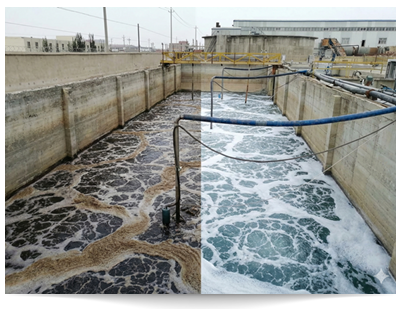
Aeration remains the single largest energy consumer in wastewater treatment. Traditional blowers and diffusers struggle with declining oxygen transfer efficiency (OTE) under real-world Mixed Liquor Suspended Solids (MLSS), fouling, and load variation. The nanobubbles can be integrated with appropriate mixing unit in the aeration tanks of Activated Sludge (ASP), Sequential Batch Reactor (SBR), Moving Bed – Bioreactor (MBBR) and offers exceptionally high gas–liquid interfacial area, uniform DO distribution even at lower bulk DO setpoints, elimination of dead zones and short-circuiting, enhanced nitrification kinetics under reduced aeration power.
The output of the integration of nanobubbles are lower blower energy, up to 40% shorter HRT, higher ammonia removal stability, and improved sludge health without increasing the tank volume. Thus, nanobubbles effectively allow operators to “aerate smarter, not harder.”
Tertiary Treatment: Making Polishing Units Work Smarter
Tertiary systems often become victims of upstream variability. Filters clog, membranes foul, and disinfection demand escalates not due to poor technology, but unstable feed water. In this case, nanobubbles acts as a polishing multiplier such as pre-conditioning of sand, carbon, and membrane feeds, biofouling suppression agent without chemical overdosing, enhanced oxidation when combined with ozone, improved UV, and chlorination efficiency. For reuse-oriented plants, nanobubbles act as a quality stabiliser, ensuring polishing units operate within design envelopes for longer durations. The overall outcomes are longer filtering runs, reduced Cleaning-in-place (CIP) frequency, lower disinfectant demand, and higher reuse confidence.
Why This Matters Now: Energy, Carbon & Circularity
Every kWh saved in aeration translates directly to carbon reduction. Every chemical avoided reduces embedded emissions. Every cubic metre reused reduces freshwater abstraction.
NICO’s nanobubble systems align seamlessly with:
- Net-zero roadmaps
- ESG-linked infrastructure financing
- Performance-based O&M contracts
- Decentralised and modular STP designs
This is not incremental optimisation and it is process leverage.
Nanobubble generators are Add-On, Not Rip-Out
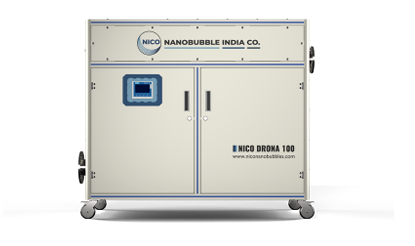
One of NICO’s strongest differentiators is its non-intrusive deployment philosophy is Skid-mounted, side-stream or inline integration, with no major civil modifications, compatible with existing blowers, tanks & controls & scalable from pilot to multi-MLD installations.
This makes nanobubbles uniquely suited for brownfield retrofits, where most real-world wastewater capacity resides.
Conclusion: The Intelligent Layer in Modern Wastewater Treatment through leveraging the legacy of nanobubbles
As wastewater infrastructure transitions from compliance-driven to performance-driven, technologies that enhance what already exists will define the next decade. NICO Nanobubble Technology functions as an intelligent process layer that amplifying oxygen transfer, stabilising biology, reducing chemical dependency, and unlocking energy savings across the entire treatment train. In primary, secondary, and tertiary stages alike, nanobubbles convert conventional assets into future-ready systems.